
Answer Engine Optimization (AEO): How to Write Answers AI Can Quote
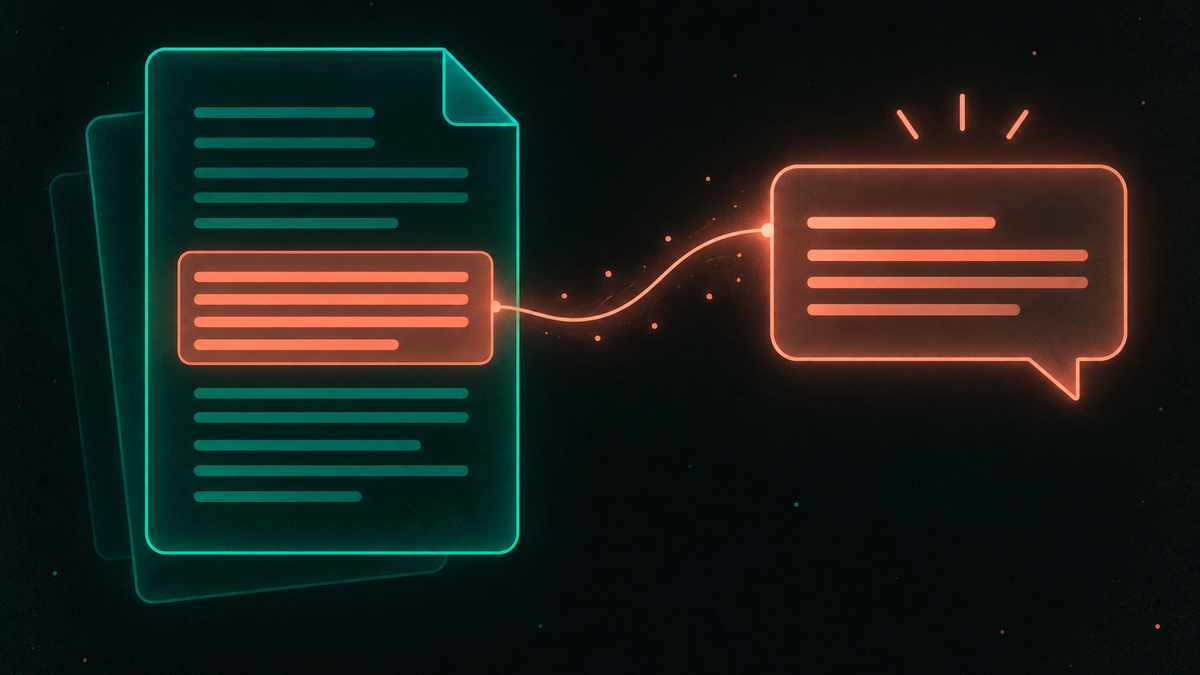
An answer engine does not send a reader to your page and hope they find the answer. It finds the answer for them, usually a passage of a few sentences, and quotes or paraphrases it. Answer engine optimization (AEO) is the work of writing those passages so that they are easy to find, easy to lift out and accurate on their own. This guide stays at that level: the page and the paragraph. For the strategy around it - crawler access, research and measurement - see our GEO guide, and if AI Overviews have already cost you clicks, our plan to recover traffic from AI Overviews.
Key Takeaways
- Answer engines retrieve passages. Google has ranked individual passages since 2020, and AI search systems ground their answers in retrieved text.
- Microsoft's guidance for AI answers is specific: descriptive headings, one- to two-sentence direct answers, Q&A pairs, lists and tables, and no answers hidden in tabs, images or PDFs.
- A reported 2026 analysis of 18,012 ChatGPT citations found 44% came from the first 30% of the page. Put the answer early.
- Some popular levers matter less than claimed: adding schema produced no significant citation change in Ahrefs' May 2026 test, Google stopped showing FAQ rich results on May 7, 2026, and page length showed near-zero correlation with AI Overview citations.
What Is Answer Engine Optimization?
Ahrefs defines AEO as making content visible and useful to AI systems that deliver direct answers: AI Overviews, voice assistants and chat assistants. The term dates from the 2017-2018 era of voice search and featured snippets, when the "answer" was the paragraph a smart speaker read aloud. Who coined it is disputed; the earliest dated uses are from early 2018.
The idea has not changed, only the engines. Today the answer is assembled by Google AI Overviews and AI Mode, ChatGPT, Perplexity and Copilot, and they can quote several sources in one response. Each of those sources earned its place with a passage that answered part of the question well.
How Answer Engines Pick a Passage
Three mechanisms are documented:
- Passage ranking. In October 2020 Google announced it could better understand the relevance of specific passages within a page, and expected the change to improve 7% of search queries. A strong answer buried in a long page can be found on its own.
- Retrieval and grounding. Google's 2026 generative AI optimization guide describes retrieval-augmented generation - retrieving relevant text and grounding the answer in it.
- Query fan-out. The same guide describes AI search running several related searches for one question, then combining what it finds. Your page can be retrieved for a sub-question you never targeted, if one section answers it cleanly.
The practical consequence: every section should be able to stand alone as the answer to one question.
Eight Rules for Writing Answers AI Can Quote
1. Put the question in the heading
Microsoft describes headings as chapter titles that define clear content slices. When the heading is the question ("How long does a passport renewal take?"), the section beneath it is unambiguously the answer. In the reported 2026 ChatGPT citation analysis, most cited questions came from headings rather than body text. Our Question-Format Headings check flags pages whose H2s never phrase a question.
2. Answer in the first one or two sentences
Microsoft's guidance asks for one- to two-sentence responses that directly address a question, and notes that assistants can often lift Q&A pairs word for word. Write the answer first, then the explanation, the caveats and the examples. The Self-Contained Answer Passages check scores exactly this.
3. Lead with a definition when the question is "what is"
For definitional questions, start with "X is..." The same reported analysis found definitional phrasing roughly twice as common in cited text as elsewhere. A definition is the easiest kind of sentence to quote accurately.
4. Front-load the page
The analysis reported that 44.2% of ChatGPT citations came from the first 30% of the page, 31.1% from the middle and 24.7% from the final third. A long introduction pushes your best answer into the part of the page that is cited least. Our Content Front-Loading check measures how early the page gets to the point.
5. Make each paragraph stand on its own
A passage quoted out of context loses everything around it. "As mentioned above" and "this approach" break when the paragraph above is gone. Name the subject in each paragraph and keep one idea per paragraph; the Paragraph Atomicity check flags paragraphs that pack several.
6. Use lists for steps and tables for comparisons
Microsoft calls out bulleted lists, numbered steps and comparison tables as clean, reusable segments, especially for how-to queries and feature comparisons. If the content is a sequence, number it; if it compares options on the same attributes, put it in a table.
7. Keep the answer in visible text
Microsoft warns that AI systems may not render hidden content, so answers inside tabs or accordions may be missed, and that key information inside images reduces accuracy. It also advises against keeping core information only in PDFs. Google likewise advises keeping important content in text. If the answer matters, it belongs in the HTML as plain text.
8. Back the answer with a fact and a source
The original GEO research found that adding statistics, quotations and cited sources raised visibility in generative answers more than any style change. An answer with a number and a named source is both more quotable and easier for the engine to trust.
A Before-and-After Rewrite
Before:
When it comes to choosing the right standing desk, there are a lot of factors that people often overlook. In our experience, which spans many years of testing, the height range is one that comes up again and again, and it's worth taking the time to think about it carefully before you buy.
After:
What height range should a standing desk have? Choose a desk whose range runs from about 5 cm below your seated elbow height to 5 cm above your standing elbow height. For most adults between 160 and 190 cm tall, that means roughly 65-125 cm. Measure your elbow height in both positions before you buy.
The second version puts the question in bold, answers in the first sentence, gives a number and an action, and makes sense if it is the only thing a reader - or an answer engine - sees. The numbers here are illustrative; use the measurements and sources that apply to your product.
What Matters Less Than You Think
Schema markup on its own. Ahrefs compared 1,885 pages that added JSON-LD with 4,000 control pages in May 2026: citation changes in ChatGPT (+2.2%) and AI Mode (+2.4%) were not significant. Google says there is no special schema.org markup needed for AI features. Keep structured data accurate for search features; do not expect it to make a page quotable.
FAQ rich results. Google's FAQ rich results stopped appearing in Search on May 7, 2026. A clear FAQ section can still help readers and answer engines, but the markup no longer earns a rich result. We covered the shift in FAQ sections AI search cites.
Length. Ahrefs' December 2025 study of 174,048 pages found a correlation of 0.04 between word count and being cited in AI Overviews. Cited pages averaged about 1,280 words, but long pages were not favored for being long.
Chunking everything. Google's 2026 guide says there is no requirement to break content into tiny pieces or write in a special way for AI. Microsoft's guidance leans the other way, toward clear slices. The common ground is headings and direct answers - not a page cut into fragments.
How to Check Your Own Pages
Pick a page and read only its headings and the first sentence under each one. If that skim answers the questions the page targets, an answer engine can do the same. Then run it through our audit: the answer passages, front-loading, question-format headings and paragraph atomicity checks test these rules directly, with a fix for each issue.
Sources
- What is AEO - Ahrefs
- Guide to optimizing for generative AI features - Google Search Central, updated July 2026
- AI features and your website - Google Search Central
- Optimizing your content for inclusion in AI search answers - Microsoft Advertising, Oct 2025
- Search On 2020: passage ranking - Google
- ChatGPT citations study: 44% from the first third of content - ALM Corp summary of Kevin Indig's Growth Memo analysis, Feb 2026
- Does schema help AI citations? - Ahrefs, May 2026
- Short vs long content in AI Overviews - Ahrefs, Dec 2025
- FAQPage structured data changelog - Google Search Central
- GEO: Generative Engine Optimization - Aggarwal et al., KDD 2024