ChatGPT SEO: How ChatGPT Chooses Which Sites to Cite
ChatGPT has more than 900 million weekly users, according to OpenAI, and a growing share of their questions trigger a web search. When it searches, it cites sources and links to them. "ChatGPT SEO" is the work of making your site one of those sources. Unlike Google, OpenAI publishes very little about how it ranks results, so this guide sticks to what can be verified: OpenAI's own documentation, what large citation studies found, and the steps that follow from both.
Key Takeaways
- Eligibility is a robots.txt decision. Sites that block OAI-SearchBot will not be shown in ChatGPT search answers, per OpenAI. GPTBot is the separate training crawler; blocking it does not remove you from search.
- ChatGPT search uses third-party search providers alongside its own crawler. OpenAI's help center links Microsoft's privacy statement among them; it does not say how much ChatGPT relies on Bing.
- OpenAI publishes no ranking factor list. It says results are ranked using multiple factors and that placement is not guaranteed, and that ads do not influence answers.
- Studies agree on authority and freshness, and disagree on search overlap. SE Ranking found referring domains and recent updates correlate with citations; Seer measured 87% overlap with Bing's top results in early 2025, while Ahrefs measured about 8% overlap with Google's or Bing's top 10 in August 2025.
- ChatGPT tags its referrals with
utm_source=chatgpt.com, so you can measure the traffic in your analytics.
How ChatGPT Search Works, According to OpenAI
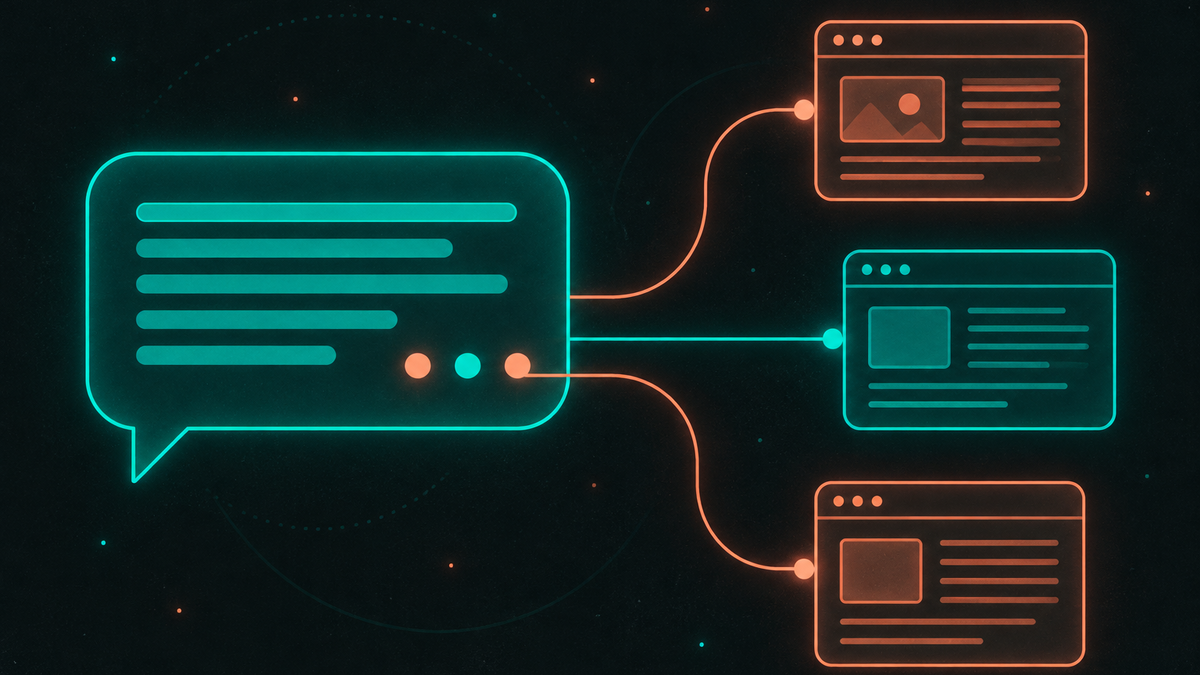
OpenAI's help article on searching the web with ChatGPT describes the flow. ChatGPT may search automatically when a question would benefit from current information, or the user can choose search manually. It typically rewrites the question into one or more targeted queries and sends them to search providers, then writes an answer with citations and a Sources panel listing the cited pages and other relevant links.
Three details from OpenAI's documentation matter for site owners:
- Two ways in. ChatGPT search can draw on OpenAI's own crawler, OAI-SearchBot, and on third-party search providers. The help article links Microsoft's and Shopify's privacy policies as providers. It does not name Bing directly or say how results are blended.
- Ranking is not documented in detail. OpenAI says ChatGPT ranks results using multiple factors intended to surface relevant, reliable information, and that placement is not guaranteed. There is no list of factors.
- Answers are not for sale. OpenAI's advertising announcement in January 2026 states that ads do not influence the answers ChatGPT gives; ads are separate and labeled. For shopping, OpenAI says product results are not ads and are not influenced by partnerships.
Step 1: Make Your Site Eligible
OpenAI's crawler documentation and its publisher FAQ give the rules:
- Allow OAI-SearchBot in robots.txt. OpenAI is explicit that sites opted out of OAI-SearchBot will not be shown in ChatGPT search answers, though they can still appear as plain navigational links. Changes take about 24 hours to apply.
- Do not block it at the firewall. OpenAI asks that your host or CDN allow its published OAI-SearchBot IP addresses. A robots.txt allow is useless if a bot-protection rule returns 403.
- Decide on training separately. GPTBot collects data for model training. Blocking it keeps your content out of training without affecting search visibility; our GPTBot guide shows the robots.txt for both decisions.
- Use noindex to stay out entirely. If a blocked page is known to OpenAI through a third-party provider, it can still show up as a link and title. To remove it, OpenAI's FAQ says to use the
noindexmeta tag - and the crawler has to be allowed to read the page to see it.
User-initiated visits come from a different agent, ChatGPT-User, which fetches a page when someone asks ChatGPT to look at it. OpenAI notes that robots.txt rules may not apply to it, because a person triggered the request.
Our AI Bot Access Rules check shows how your robots.txt treats OAI-SearchBot, GPTBot and the other AI crawlers.
Step 2: Make Your Pages Readable to the Crawler
In Vercel and MERJ's crawl analysis, OAI-SearchBot, ChatGPT-User and GPTBot fetched pages without running JavaScript, so content that only appears after client-side rendering is invisible to them. OpenAI's documentation does not address rendering. We covered the evidence in which AI crawlers render JavaScript, and our JavaScript Content Gap check flags pages whose raw HTML is missing the content.
Step 3: Understand What ChatGPT Tends to Cite
No study can see inside ChatGPT's ranking, but several large ones looked at what it cites. All of them show correlation, not cause.
- Authority and freshness. SE Ranking's analysis of 216,524 pages across 129,000 domains, reported by Search Engine Journal in November 2025, found referring domains were the strongest predictor: domains with up to 2,500 referring domains averaged 1.6-1.8 citations, those above 350,000 averaged 8.4. Pages updated within three months averaged 6 citations versus 3.6 for outdated pages. Long articles (over 2,900 words) averaged 5.1 versus 3.2 for those under 800 words.
- Search overlap is disputed. Seer Interactive found that over 87% of SearchGPT citations matched Bing's top organic results in February 2025 - on a small sample of 100 queries. Ahrefs' August 2025 study of 15,000 long-tail prompts found only about 8% overlap between ChatGPT's in-text citations and the top 10 in either Google or Bing. Ranking well in Bing may help, but it is far from a guarantee.
- Community and reference sites dominate the top. Ahrefs' September 2026 ranking puts Reddit first with 16.8% of mention share and Wikipedia second with 7.0%. Semrush saw both swing sharply within weeks in 2025, so the mix changes often.
- Some tactics showed nothing. In the SE Ranking data, pages with FAQ schema scored slightly lower than pages without it, and llms.txt had negligible impact.
What this suggests in practice: be the kind of source others reference, keep important pages current, and be present where ChatGPT already looks, including the communities in your niche.
Step 4: Write Pages ChatGPT Can Quote
ChatGPT quotes passages. A section that answers one question directly, with a specific fact and a source, is easier to cite than a long build-up. The practical rules - question-style headings, answer in the first sentence or two, one idea per paragraph, lists and tables for structured information - are in our guide to answer engine optimization. The Self-Contained Answer Passages check tests your pages against them, and the Content Freshness check flags pages that look stale.
Step 5: Measure ChatGPT Traffic
OpenAI's publisher FAQ states that ChatGPT automatically adds utm_source=chatgpt.com to referral URLs. In Google Analytics 4, that traffic appears under the source chatgpt.com; GA4 also groups ChatGPT and other assistants in an AI Assistant channel. In your server logs, look for the OAI-SearchBot user agent to confirm the crawler reaches your pages, and verify the IPs against OpenAI's published list.
Our guide to measuring AI visibility covers the GA4 setup and log checks in detail. For scale: SE Ranking's analysis of 101,574 sites found ChatGPT referrals made up 0.32% of all website traffic in May 2026 - small, but growing month over month, and ChatGPT accounted for about three quarters of AI-assistant referrals. The same study found 60% of AI-referred visits land on homepages, compared with 17% from organic search, which makes your homepage's clarity more important than usual.
A ChatGPT SEO Checklist
- Allow OAI-SearchBot in robots.txt and in your firewall or CDN rules.
- Decide on GPTBot (training) separately.
- Serve your content in the initial HTML.
- Keep important pages updated, and show the date.
- Answer questions directly under descriptive headings, with facts and sources.
- Earn references: links and mentions from respected sites and communities.
- Track
utm_source=chatgpt.comin analytics and OAI-SearchBot in your logs.
Sources
- Searching the web with ChatGPT - OpenAI Help Center
- Publishers and developers FAQ - OpenAI Help Center
- Overview of OpenAI crawlers - OpenAI
- Our approach to advertising and expanding access - OpenAI, Jan 2026
- Scaling AI for everyone - OpenAI, Feb 2026
- New data: top factors influencing ChatGPT citations - Search Engine Journal, Nov 2025
- 87% of SearchGPT citations match Bing's top results - Seer Interactive, Feb 2025
- AI search overlap with Google and Bing - Ahrefs, Aug 2025
- Most cited domains in ChatGPT - Ahrefs, Sep 2026
- Most cited domains in AI - Semrush, Nov 2025
- ChatGPT referral traffic, May 2026 - SE Ranking
- The rise of the AI crawler - Vercel and MERJ, Dec 2024