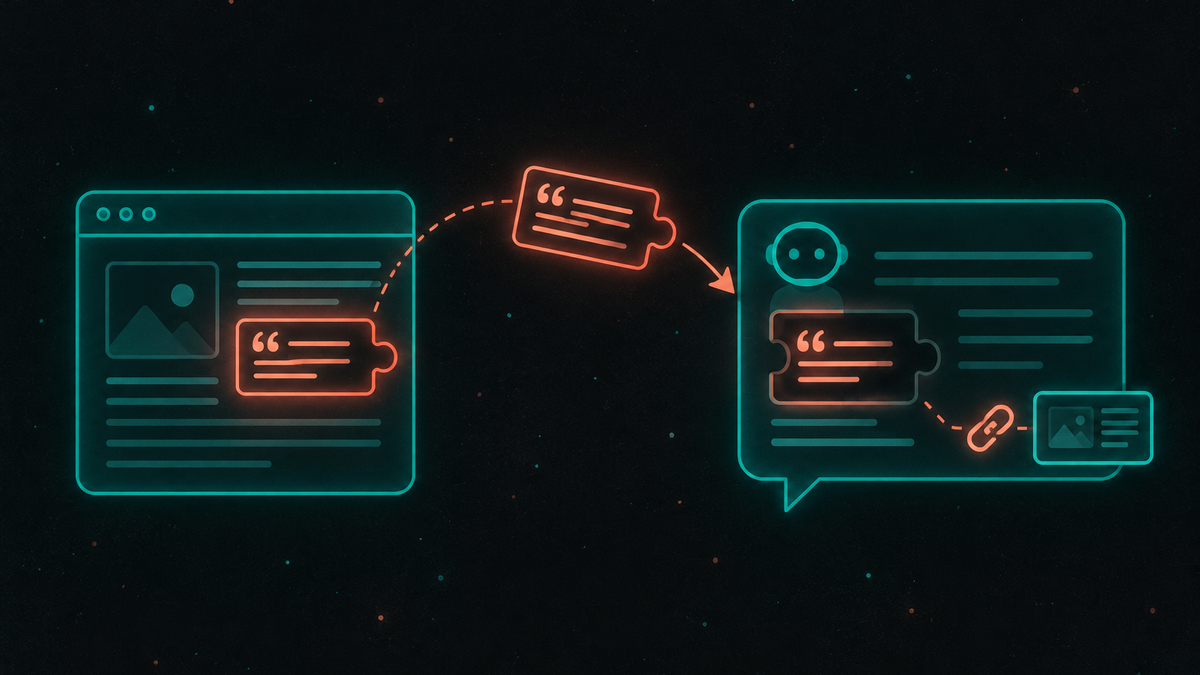
GEO vs SEO: What Changes, What Stays the Same, and What the Data Shows

"Generative engine optimization" entered the vocabulary through a 2023 research paper from Princeton, Georgia Tech, the Allen Institute for AI and IIT Delhi, which showed that some changes to a page could raise its visibility in AI-generated answers by up to 40%. Since then GEO has been sold as a new discipline that replaces SEO. Google's position is the opposite: its own AI optimization guide says that optimizing for generative AI search "is optimizing for the search experience, and thus still SEO".
Both are partly right. The work that gets a page into AI answers is mostly the work that gets it into search results. What changes is the scoreboard. In a Pew Research study of 68,879 Google searches, users clicked a result on 8% of visits when an AI summary appeared and on 15% when it did not. This post lays out what stays the same, the five things that actually differ, and what to adjust.
Key Takeaways
- The foundation is shared. Google says there are "no additional requirements" to appear in AI Overviews or AI Mode beyond being indexed and eligible for a snippet.
- Selection is wider than ranking. Only 37.9% of URLs cited in AI Overviews ranked in Google's top 10 for the query in Ahrefs' March 2026 data, down from 76.1% in mid-2025.
- Clicks fall when AI answers appear. Ahrefs measured a 58% lower click-through rate for the top result on queries with an AI Overview; being cited partly offsets this.
- Different sources win. An analysis of AI search citations found a strong preference for earned media - third-party coverage - over brands' own pages.
- The tactics overlap, with exceptions. In the GEO paper, adding quotations, statistics and cited sources raised visibility; keyword stuffing lowered it by 9%.
What Is the Difference Between GEO and SEO?
SEO aims to rank a page in a list of results and win the click. GEO aims to have a page selected, quoted or cited inside an answer an AI system writes - in Google's AI Overviews and AI Mode, ChatGPT, Perplexity or Copilot. Our GEO guide defines the term and its siblings, and our LLM SEO guide explains the training and retrieval channels behind AI answers; this post compares GEO and SEO in practice.
| SEO | GEO | |
|---|---|---|
| Goal | Rank and earn the click | Be selected and cited in the answer |
| Unit that competes | A whole page | A passage or fact from a page |
| Success metric | Positions, clicks, CTR | Citations, mentions, AI referrals |
| Main data source | Search Console performance | Bing AI Performance, AI referral traffic, trackers |
| Stability | Rankings move over days and weeks | The same prompt can return different sources each time |
Action: keep reporting SEO and GEO results separately, so a drop in clicks is not read as a drop in visibility.
What Stays the Same
Google is explicit that the foundation does not change. Its AI features documentation says: "There are no additional requirements to appear in AI Overviews or AI Mode, nor other special optimizations necessary." A page must be indexed and eligible to be shown with a snippet, and there is "no special schema.org structured data that you need to add". John Mueller made the same point in Google's May 2025 guidance: "The underpinnings of what Google has long advised carries across to these new experiences."
Microsoft says much the same about Copilot. In its October 2025 guidance it writes that "there's no secret strategy for being selected by AI systems."
So crawlability, indexing, page quality and a clear answer near the top of the page serve both. Outside Google, one prerequisite is easy to miss: AI search engines use their own crawlers, such as OAI-SearchBot and PerplexityBot, which robots.txt has to allow. Our AI crawlers list covers them.
Action: before any GEO work, confirm that key pages are indexed in Google and Bing and that AI search crawlers are not blocked.
Difference 1: Being Selected Is Not the Same as Ranking
AI answers pull from more pages than the top ten. Google describes AI Overviews and AI Mode as using "query fan-out" - issuing multiple related searches across subtopics. The effect shows up in citation data: Ahrefs found in July 2025 that 76.1% of URLs cited in AI Overviews ranked in the top 10 for the query; by its March 2026 study that share was 37.9%, with 31.0% of citations coming from pages outside the top 100.
For SEO this means a page can be cited without ranking well for the main query, because it ranks for one of the sub-questions the system asked. Microsoft describes the same shift: what matters is "which pieces of content earn a place in the final answer", not only the order of whole pages.
Action: cover the follow-up questions around a topic on the page - definitions, comparisons, costs, steps - not only the head query.
Difference 2: Clicks vs Citations
The biggest practical difference is traffic. In Pew's March 2025 panel of 900 US adults, users clicked a search result on 8% of visits with an AI summary and on 15% without one; about 1% clicked a link inside the summary itself. Google disputed the study, calling it "a flawed methodology and skewed query-set", and says clicks from AI features are "higher quality".
Independent measurements point the same way. Ahrefs found that an AI Overview correlated with a 58% lower click-through rate for the top-ranking page in December 2025, up from 34.5% in its earlier study. Seer Interactive measured organic CTR of 0.61% on queries with an AI Overview against 1.62% without, across 3,119 terms. Seer also found that pages cited in the AI Overview had higher CTR than pages that were not (0.70% vs 0.52%), though it notes it "cannot definitively prove that citation causes higher CTRs."
Action: track AI citations as their own metric, and judge pages on informational queries by citations and conversions, not by clicks alone.
Difference 3: Different Sources Win
SEO rewards the page that best answers a query. AI answers often prefer what others say about you. A 2025 study by Chen et al. found that AI search engines show "a systematic and overwhelming bias towards Earned media (third-party, authoritative sources)", in contrast to Google's more balanced mix of brand, earned and social sources. For US automotive queries, earned media made up 81.9% of AI search citations against 45.1% for Google.
This shifts some of the work outside your own site: reviews, comparisons and coverage on sites that AI systems already cite. Our post on original research as an AI citation signal covers the on-site side - data others will quote - and our guide on how to get cited by AI breaks the sources down by engine.
Action: list the third-party sites that appear in AI answers for your topics and treat being mentioned there as part of the plan.
Difference 4: Some Tactics Diverge
Most good SEO practice helps GEO, but the GEO paper found clear differences at the passage level. Adding quotations raised visibility by 43%, adding statistics by 33% and citing sources by 28%, while keyword stuffing - a legacy SEO habit - lowered it by 9%. The gains were largest for lower-ranked pages: citing sources raised visibility by 115.1% for the page ranked fifth. The full table is in our GEO guide, and our answer engine optimization guide turns it into writing rules.
In our audit, the answer passages, sources section and original research checks look at these signals on a page.
Action: rewrite the key passages of your top pages with a sourced number or a quotation, and remove repeated keywords that add nothing.
Difference 5: Measurement Is Less Stable
SEO has a stable reporting base: positions, impressions and clicks in Search Console. GEO measurement is newer and noisier. Bing's AI Performance report counts how often pages are cited in AI answers - "not page importance, ranking, or placement". Answers also vary from run to run, so a single prompt check proves little. Our guide to measuring AI visibility shows a setup that combines Search Console, Bing, analytics and server logs.
Action: measure AI visibility over many prompts and weeks, and never draw conclusions from one screenshot of one answer.
What to Change in Your SEO Process
| Keep doing | Add for GEO | Stop |
|---|---|---|
| Technical SEO, indexing, page quality | Allow AI search crawlers in robots.txt | Keyword repetition for its own sake |
| Answering the main query early | Cover follow-up questions on the same page | Judging informational pages by clicks alone |
| Earning links | Earning mentions on sites AI answers cite | Separate "AI-only" versions of pages |
| Search Console reporting | Citation tracking in Bing and AI referral traffic | Buying "AI ranking" schema or text files |
GEO is not a replacement for SEO; it is SEO measured against a second scoreboard. To see how your pages do on both - crawler access, passage structure, sources and technical SEO - run a free audit.
Sources
- GEO: Generative Engine Optimization - Aggarwal et al., KDD 2024
- AI optimization guide - Google Search Central
- AI features and your website - Google Search Central
- Top ways to ensure your content performs well in Google's AI experiences on Search - Google, May 2025
- Optimizing your content for inclusion in AI search answers - Microsoft Advertising, October 2025
- Google users are less likely to click on links when an AI summary appears - Pew Research Center, July 2025
- AI Overviews reduce clicks (update) - Ahrefs, February 2026
- AIO impact on Google CTR, September 2025 update - Seer Interactive
- Search rankings and AI citations - Ahrefs, July 2025
- AI Overview citations and the top 10 - Ahrefs, March 2026
- Generative Engine Optimization: How to Dominate AI Search - Chen et al., 2025